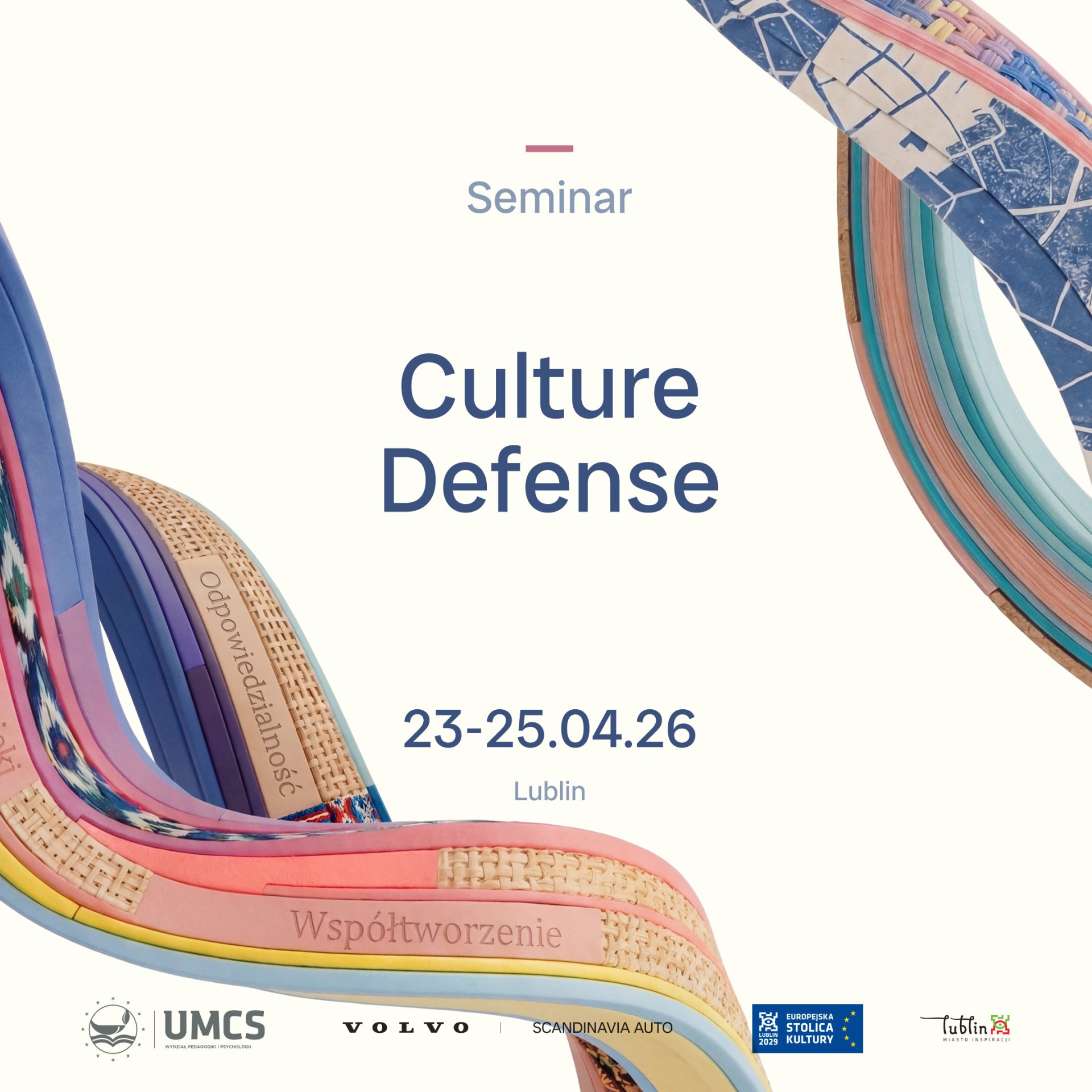
Culture Defence Seminar – Lublin, 23–25 April 2026
Culture has the power to heal, to inspire hope, to build bonds, and to strengthen resilience in times of challenge. Yet it can also lead to burnout and intensify crises. It is therefore a force of immense potential—one that, when thoughtfully navigated, can support social change.On behalf of the European Capital of Culture Lublin 2029, we invite you to the interdisciplinary seminar Culture Defence / Kultura Ochrony, which will take place in Lublin from 23 to 25 April 2026.
Over the course of three days, the seminar will bring together the knowledge of researchers, the experience of artists, and the practice of cultural practitioners and public policy makers with experience in European Capitals of Culture. The seminar will become a space for the exchange of experiences, regeneration, and co-creation.
The central theme of the meeting is resilience in culture, explored in relation to health, community and creative work, team wellbeing, and information security. We will reflect on how resilience is understood differently depending on geopolitical context, and how its definitions can diverge in profoundly contrasting ways. The resilience we address is a constructive and critical potential that seeks to strengthen shared responsibility. Intertwined with culture, it forms a foundation that reinforces democratic resilience and social cohesion, supporting the pursuit of Re:Union, as outlined in Lublin’s ECoC application.
The seminar is co-organized in collaboration with the Faculty of Pedagogy and Psychology at UMCS. To ensure accessibility, participation is free of charge, and support will be provided for people with special needs. Registration for workshops will open soon; due to limited capacity, participation will be granted on a first-come, first-served basis. The seminar will be held in Polish and English, with simultaneous interpretation provided. Selected lectures will also be available in Polish Sign Language (PJM).
For further information, please contact:
Marta Ryczkowska – marta.ryczkowska@lublin2029.pl
Culture Defence / Kultura Ochrony – Seminar Programme
The plenary sessions will take place at the Faculty of Psychology, UMCS (9:00–14:00), and the workshop sessions at the Faculty of Pedagogy, UMCS (15:00–18:00).
Seminar Programme: Culture Defense
Thursday, 23 April 2026
9:00 – 9:30 Welcome of guests and presentation of the seminar programme
9:30 – 11:10 | Culture as Care Infrastructure
Resilience is a critical force that not only determines survival, but also unlocks a system’s capacity for change. The experiences of European Capitals of Culture and cities operating under wartime conditions demonstrate how diverse and complex cultural actions can strengthen resilience. In times of crisis, culture becomes a foundation for both defense and hope.
Presentations and plenary session:
9:30 – 9:45 Making Sense in a Time of War: Beyond Resilience in Ukrainian Culture / Iryna Polikarchuk (Artsvit, Dnipro)
9:45 – 10:00 European Capitals of Culture: Beyond Events, Towards Care / Angeliki Lampiri (Eleusis 2023)
10:00 – 10:15 Culture as Care Infrastructure: From Symbolic Value to Social Capability / Sara Vuletić (Novi Sad 2022)
10:15 – 11:00 Conversation: Iryna Polikarchuk, Angeliki Lampiri, Sara Vuletić; Moderation: Marta Ryczkowska
11:00 – 11:20 | Break
11:20 – 12:10 | Change from Within – Well-being and Cultural Management
Can we speak about the quality of culture without the quality of its management? The starting point of the debate is the belief that the well-being of people working in cultural institutions is not a “soft add-on,” but a fundamental condition of their functioning. The conversation will focus on the tensions between systems and the everyday reality of institutional work: the responsibility of the state and cultural organizers, the actual agency of managers, and the pressures under which teams operate on a daily basis. The panel will feature: Hanna Wróblewska (long-time Director of Zachęta – National Gallery of Art, Commissioner of the Polish Pavilion at the Venice Biennale, and Minister of Culture and National Heritage in 2024–2025), Anna Długołęcka (HR expert, psychologist, trainer, and manager), and Sławomir Księżniak (Director of the Węglin District Cultural Centre in Lublin).
12:10 – 12:30 | Break
12:30 – 14:00 | The City as a Laboratory
European Capitals of Culture test mechanisms that strengthen resilience through culture. The city functions as a learning community, and a shift away from the “trauma → growth” narrative towards care, regeneration, and co-creation makes it possible to develop a catalogue of formats that can be implemented in Lublin.
12:30 – 12:55 Monitoring and Evaluation Team of the European Capital of Culture 2029 / Prof. Agnieszka Kolasa-Nowak, Prof. Radosław Mącik, Monika Ratajczyk, PhD, Andrzej Stawicki, PhD; Małgorzata Dziekanowska, PhD
12:55 – 13:10 Why Do We Need a Joint Strategy for Culture and Health in Poland? / Edyta Ruta
13:10 – 13:25 Characteristics of Lublin’s Cultural Workforce – Potentials and Challenges / Marcin Cabak, PhD
13:25 – 13:55 Conversation: Edyta Ruta (Pasmo Foundation), Marcin Cabak, PhD (UMCS), Agnieszka Wojciechowska (Workshops of Culture), Monika Ratajczyk, Andrzej Stawicki (M&E ECoC Lublin 2029)
Moderation: Aga Kozak
13:55 – 14:00 Summary and preview of the next day
14:00 | Break
15:00 – 18:00 | Workshops
The body is a source of knowledge and a site where overload accumulates. The workshops address the psychosomatic effects of project-based, activist, and curatorial work. They are multisensory in nature: activating touch, hearing, and smell, and restoring balance. Movement, somatic, and breathing practices become tools of regeneration. A set of simple, scientifically grounded techniques emerges, which can be applied within cultural institutions.
15:00 – 17:30 Music in Action – Areas of Experience, Exploration and Regulation / Prof. Krzysztof Stachyra (UMCS)
15:00 – 17:30 It’s Said It Can’t Be Done. And Yet: How to Transform a Cultural Institution from Within – into a Better Workplace / Anna Długołęcka
15:00 – 16:30 Starting from Care / Konrad Kurowski
15:00 – 18:00 A Jar of Sourdough Starter as a Tool of Survival / Łukasz Radziszewski
15:00 – 17:00 Finding Understanding. On Effective Communication in an Intercultural Environment / Iza Gawęcka
15:00 – 18:00 From Frustration to Connection – How to Engage in Dialogue in Conflict. NVC Workshop / Magdalena Kosicka-Leszczyńska
19:30 – 20:45 | Centre for Culture, Bright Hall (Sala Jasna)
Sound Bath. Gong and Singing Bowl Concert / Rima Sadurska
Friday, 24 April 2026
9:30 – 11:30 | Culture as the Infrastructure of Care
Cities that have developed programmes or applied for the title of European Capital of Culture demonstrate how complex the thinking about resilience built through culture can be. Their experiences reveal a network of interconnections between cultural activities and areas such as heritage protection, mental health, and relations within democratic systems. We also highlight European initiatives that strengthen social cohesion through culture.
Presentations and plenary session:
9:40 – 10:00 Lviv’s Path to the ECoC: the competition is over, “Responsibility to Be” continues / Yuliia Khomchyn (Lviv 2030 – candidate city)
10:00 – 10:20 Resilience, care and open culture / Rosella Tarantino (Matera 2019)
10:20 – 10:40 Culture for resilience – Communities as the soft core of societal resilience / Felix Schartner Giertta (BSR Cultural Pearls)
10:40 – 11:20 The discussion will feature: Yuliia Khomchyn (Lviv 2030 – candidate city), Rosella Tarantino (Matera 2019), Felix Schartner Giertta (BSR Cultural Pearls). Moderation: Marta Ryczkowska.
11:20 – 11:40 | Przerwa
11:40 – 12:40 Building Resilience
Artistic practices and intercultural facilitation function as a safe testing ground in which one can learn cooperation, build relationships, and overcome fear, enabling instinctive and effective action in situations of real threat.
Presentations:
11:40 – 12:00 Cultural animators in the work environment – psychosocial conditions / Urszula Lewartowicz, PhD (Maria Curie-Skłodowska University), Andrzej Różański, DSc, Prof. UMCS
12:00 – 12:15 | The artist in crisis / Katarzyna Klimkowska, DSc, Prof. UMCS
12:15 – 12:30 | Intercultural facilitation and crisis resilience / Marcin Skrzypek (Brama Grodzka – NN Theatre Centre, Spacial Culture Forum)
12:30 – 12:50 | Break
12:50 – 14:00 Culture, Security and Information Resilience
Culture can strengthen critical thinking and the ability to recognise manipulation. We will examine the mechanisms of disinformation and fake news in the fields of culture, art, and public debate. We will reflect on the role of cultural institutions as social mediators and discuss practical tools such as fact-checking, crisis communication, debate moderation, and conflict management.
12:50 – 13:10 A Space of Trust. Art as an Infrastructure of Security / Bogna Świątkowska
13:10 – 13:30 In the Network of Narratives / Rafał Sakowski
13:30 – 13:55 The discussion will feature: Bogna Świątkowska (President of the Bęc Zmiana Foundation for New Culture), Rafał Sakowski (founder of the PASMO Foundation – Institute of Social Resilience), and Ada Florentyna Pawlak (lecturer at SWPS University, anthropologist of technology, lawyer, and art historian). Moderation: Aga Kozak.
13:55 – 14:00 Summary and preview of the next day
14:00 | Break
15:00 – 18:00 | Psychosomatics and Affective Labour: From Tension to Regulation
The body is a source of knowledge and a site where overload accumulates. The workshops address the psychosomatic effects of project-based, activist, and curatorial work. They are multisensory in nature – activating touch, hearing, and smell, and restoring balance. Movement, somatic, and breathing practices become tools of regeneration. A set of simple, scientifically grounded techniques emerges, which can be applied within cultural institutions.
15:00 – 18:00 Movement Toward the Future / Marysia Stokłosa
15:00-18:00 Working in Culture Without Burnout? Workshop for the Cultural Sector / Karolina Pluta
15:00-17:00 My Boundaries – Workshop on Recognising One’s Limits / Iza Gawęcka
Saturday, 25 April 2026
10:00 – 11:40 | Inclusive Communication and Intercultural Practices
This module focuses on cross-sector cooperation with migrant communities and on tools supporting inclusion and co-creation in culture. It concentrates on building community within diverse teams, as well as developing belonging, trust, and a sense of shared responsibility.
10:00 – 10:20 Inclusive Language in Practice: Tools for Accessible, Mindful, and Care-Based Communication / Jolanta Sienkiewicz-Prochowicz
10:20 – 10:40 Art as Support and an Accessible Space for People with Visual Impairments / Ewa Niesterowicz, DSc (Maria Curie-Skłodowska University)
10:40 – 11:40 The discussion will feature: Jolanta Sienkiewicz-Prochowicz (philosopher, anti-discrimination trainer), Dr hab. Margaret Ohia-Nowak (linguist, media studies scholar, UMCS), and Anna Dąbrowska (President of the Homo Faber Association). Moderation: Aga Kozak.
11:40 – 12:00 Break
12:00 – 13:30 | Empowering Artistic Practices
This module shows how artistic practices strengthen resilience and the well-being of creators. We explore performative tools in work with young people. We also analyse how institutional resilience is built and how the “health condition” of cultural institutions and art academies can be monitored.
12:00 – 12:20 Perception and Discomfort Laboratory / Paulina Kempisty
12:20 – 12:40 From Sensitivity to Resilience: Mechanisms for Building Well-being in Artistically Gifted Individuals / Małgorzata Kuśpit, DSc, Prof. UMCS
12:40 – 13:25 The discussion will feature: Paulina Kempisty (Grotowski Institute), Dr hab. Małgorzata Kuśpit, Prof. UMCS, Dr hab. Marta Bosowska (performance artist, University of the Arts in Poznań), Dr Marta Ryczkowska (ESK Lublin 2029), and Łukasz Radziszewski (artist).
13:25 – 13:30 Summary and closing of the seminar
13:30 | Break
14:30 – 16:00 | Psychosomatics and Affective Labour: From Tension to Regulation
Body and mind function on equal terms. The module includes movement, somatic, and breathing practices that support regeneration and help cope with overload in creative work.
14:30 – 16:00 Starting from Care / Konrad Kurowski
14:30 – 16:00 Mindfulness – the Practice of Awareness / Agata Semplińska
14:30 – 16:30 Boundary Practices / Marta Bosowska
The Team:
Curator and Programme Coordinator
Marta Ryczkowska
Production:
Jagoda Valkov, Izabela Raszewska
Moderation:
Aga Kozak
Contact: marta.ryczkowska@lublin2029.pl