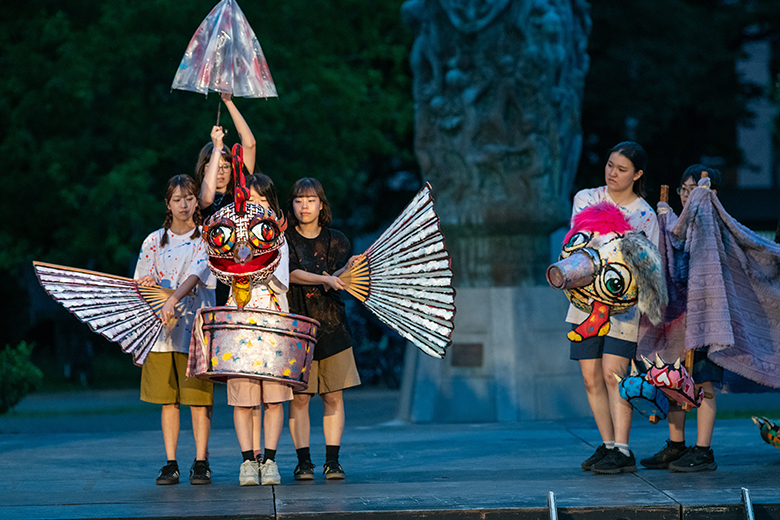
During my stay in Japan, I took part in a series of study visits and working meetings with representatives of Japanese puppet theatres. The aim of the trip was to establish international partnerships and learn about working methods that could be applied to “Rehab”, a project being developed as part of the European Capital of Culture Lublin 2029 programme.
“Rehab” explores the use of puppet theatre as a tool to support children and young people in dealing with traumatic experiences, particularly those related to war, but also natural disasters and other crisis situations.
One of the places I visited was Hitomiza Puppet Theatre in Kawasaki. I learned about the theatre’s history, its organisational model and its artistic and educational work. An important part of the visit was an introduction to the bunraku tradition, as well as practical puppet animation workshops. We also discussed the theatre’s work with children and possible cooperation on future educational and social projects. At Puk Puppet Theatre in Tokyo, our discussions focused on the repertoire, educational activities and the organisation of the theatre’s work. We exchanged experiences in theatre for children, theatre education and social projects. The possibility of developing international cooperation was also discussed. Another stop was Yamabikoza Theatre in Sapporo, where I was particularly interested in approaches to working with children and young people. We talked about how puppet theatre can support creativity, emotional expression and the development of a sense of safety. The experience of theatres working with communities affected by natural disasters provided an important context for these discussions. At Kogumaza Theatre in Sapporo, I took part in meetings marking the theatre’s 50th anniversary. It was an opportunity to learn about the institution’s history, its relationship with the local community and its long-term artistic and educational work with children. We also discussed the possibility of Japanese artists taking part in projects developed in Lublin.
An important part of the trip was the World Children’s Puppet Theatre Forum in Sapporo. During the forum, I presented the work of the H. Ch. Andersen Theatre in Lublin, including its educational, social and international projects. Alongside theatres from Thailand, Taiwan, the Czech Republic, Slovakia and Hungary, I also presented the concept behind “Rehab”. A significant part of the discussions focused on Japanese experiences of working with children following natural disasters. I was particularly interested in the work carried out after the earthquake, tsunami and Fukushima nuclear disaster. We discussed how puppet theatre can help children express their emotions, rebuild a sense of safety and return to everyday life after traumatic events.
This experience is important for the further development of “Rehab”. One of the project’s aims is to establish an international network of experts: psychologists, educators and artists who use puppet theatre in their work with children and young people affected by trauma. Japanese experience could become one of the points of reference for developing this model.
During the meetings, we also discussed ways of involving Japanese artists, educators and specialists in the activities of European Capital of Culture Lublin 2029. Ideas included workshops, artistic residencies, knowledge exchange, as well as joint research and educational projects.
The visit to Japan was therefore not only an opportunity to learn more about the traditions of puppet theatre and contemporary approaches to working with children. It also opened discussions about long-term cooperation between institutions in Japan and Lublin. This could lead to joint activities for children and young people who have experienced trauma.
Text: Agata Sakowicz