Local-SoMe’25 in Wrocław is the only event in Poland entirely dedicated to effective local government communication, and centered on the question, “How to communicate in a way that is meaningful and effective?” The Congress’s structure reflected the actual communication cycle: from the birth of an Idea, through Content and Publication, to Interaction, Reception, and Analysis.
Lublin 2029 RE:UNION was actively represented during the panel titled “Talking about culture to make it visible and memorable.” The discussion focused on the challenges cultural institutions with limited budgets and resources face when promoting their activities. Among the participants was Małgorzata Drozd-Domaciuk, who is involved in communication for ECoC Lublin 2029 and the Centre for Culture in Lublin.
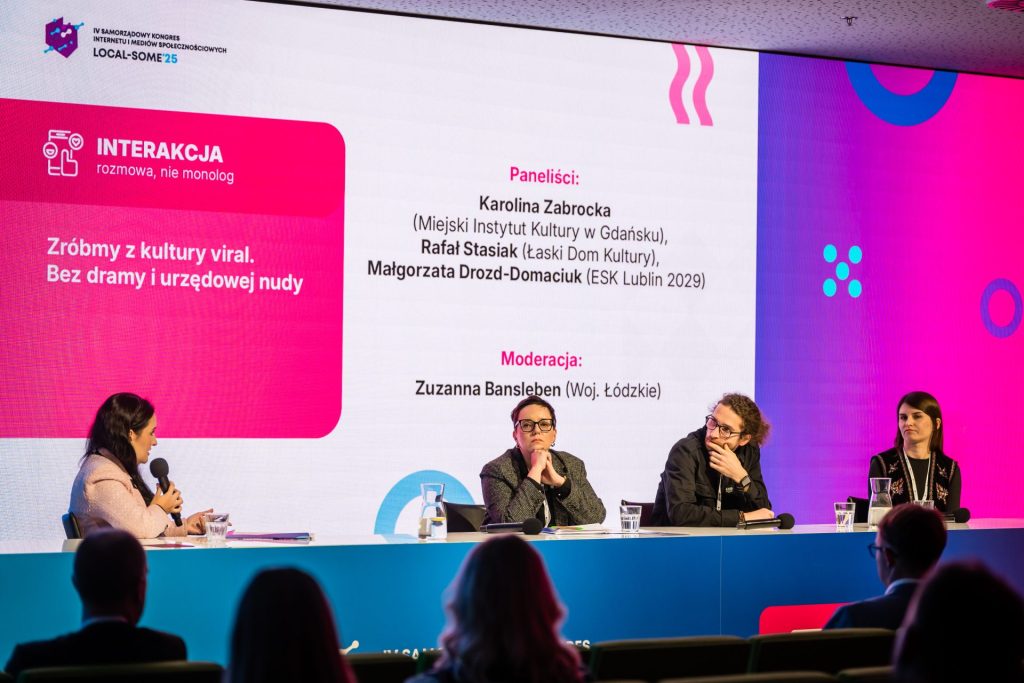
During the Congress, speakers emphasized that in a world where being active on social media has become a must, simply “being there” is no longer enough. Communication cannot be merely aesthetic; it must also be clear and strategic rather than chaotic. It has to build relationships and start with a understanding of why we communicate, and who we are communicating to. One of the key topics was the need to break away from excessive formality in communication. In order to make notices and announcements sound less official, it is necessary to leave behind “official language” in favour of a more engaging way of speaking.
The Congress called for public institutions to communicate local issues “simply, accurately and with local energy”. Every city has its own authentic atmosphere – its own Idea. For Lublin 2029, this Idea is expressed through the slogan RE:UNION, symbolising the reunion of people, institutions and values. It is a response to the crisis of relationships and hope. In line with the values of the Union of Lublin – “Free with the free, equal with the equal” – Lublin manifests that culture can serve as a bridge rather than a barricade.
The European Capital of Culture Lublin 2029 (RE:UNION) is a project aimed at rebuilding social and digital ties. Culture is a strategic instrument of change here, which squares with the European Union’s understanding of culture being the foundation of public life. 
Another important part of the discussion was the role of interaction, as demonstrated by the “3000 Dreams” phenomenon. Lublin’s approach to its competition application started with listening to its residents. Inviting people to share visions of Lublin in 2029 resulted in over 3,000 ideas which inspired a 100-page bid book. The most common dreams and expectations were free cultural education for children and teenagers, a green city and international events.
This process became an example of communication based on dialogue and co-creation. Lublin 2029 perceives the ECoC as a laboratory for change, and a commitment in which communication is to genuinely support long-term goals, such as doubling participation in culture and providing free cultural education.
Translated by: Aleksandra Górecka
Proofread by: Zofia Świerszcz