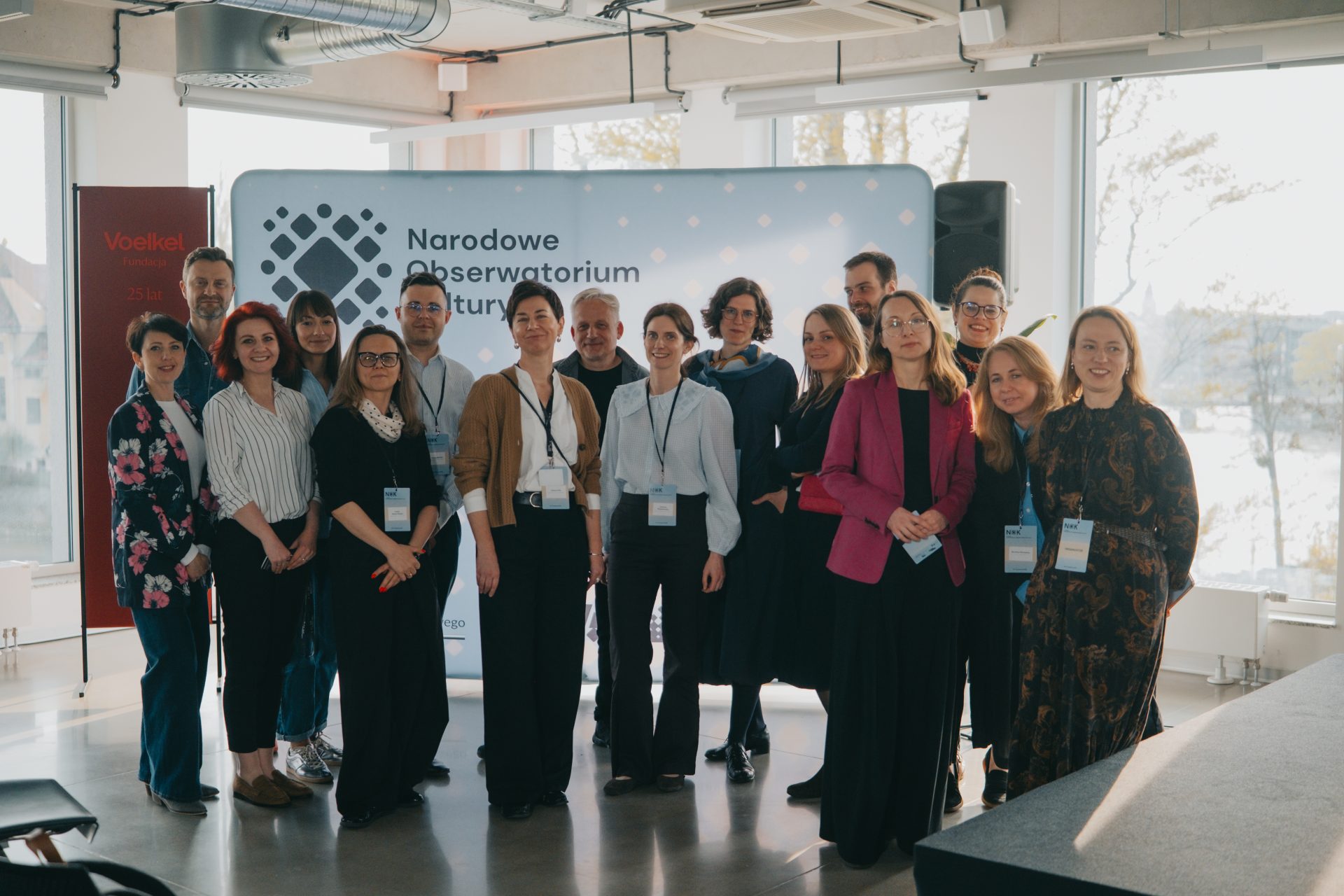
The Wrocław Forum of the National Culture Observatory started with a question resonating ever more strongly throughout the whole cultural sector: do cultural institutions still know how people really engage in culture?
For years, we have measured culture by attendance figures, ticket sales and turnout at events. Meanwhile, everyday cultural practices are increasingly taking place outside the walls of institutions: in headphones on the way to work, on social media, in the act of watching a TV series, in the micro-rituals that organise the daily life. Culture has not disappeared. It has merely changed its location, pace and mode of presence.
It was precisely this change that the 2nd Forum of the National Observatory of Culture in Wrocław focused on. The event brought together 200 representatives of cultural institutions, researchers and organisations involved in analysing the cultural sector in Poland. Two eventful days featured multiple panels and debates addressing the broader role of cultural research. Discussions centred on the purpose and practical implementation of research findings in everyday practice, translating needs into institutional outcomes, and incorporating a research perspective into the creation of cultural policies.
Together with the speakers, we analysed social phenomena that truly change cultural engagement in the geopolitical and local context. The forum began with a summary of the NOoC activities over the past year and a presentation of the report Active and Absent. Contextual research into cultural participation (Aktywni i nieobecni. Kontekstowe badania uczestnictwa w kulturze) held by Marek Krajewski from Adam Mickiewicz University in Poznań. He presented surprising findings regarding the ways in which people interact with culture and draw on it in the everyday life context. The survey was conducted during the panel, using the CAWI method on a sample of 1,026 people representative of the Polish population.
As it turned out, people are most likely to engage with culture outside the walls of institutions; therefore, it is important to rethink its role and answer the question – what should a public cultural space become in order to meet social needs and challenges?
The key findings of the report are as follows:
– Cultural institutions are an incredibly important part of the ecosystem of cultural engagement, and both supporting them and strengthening their public character is essential to the existence of harmoniously developing communities.
– Cultural engagement is deeply rooted in everyday instrumental activities.
– Interaction with culture is highly mediated by networked media, and often takes place entirely outside the realm of cultural institutions.
– Everyday cultural engagement does not directly involve cultural institutions; however, this does not mean that their resources are not utilised or that they do not play a significant role.
– Everyday cultural engagement often manifests as a solitary practice and serves an isolating rather than a socializing role.
– Interaction with culture is not a random collection of activities, but a patterned practice. This, in turn, allows us to identify several segments of people engaging in culture.
– An important aspect of contemporary culture is its strong aurality, which is particularly present in everyday life and highlighting social differences in an interesting way.
– The main factors determining the intensity of everyday cultural activities are education, gender and occupational status and not financial situation, place of residence or household size.
– The ways in which women and men engage with culture differ not so much in terms of intensity, but rather in terms of temporality and how deeply they are embedded in everyday life.
– Differences in how culture is experienced across age groups are reflected not so much in intensity, but rather in the way they access it and the types of cultural activities they choose to pursue.
– The level of institutional cultural engagement is relatively low, partly due to a lack of accessibility for some social groups.
Why are the findings of this report so significant for our sector? First and foremost, they show a shift in the perception of cultural engagement and a transition from estimating attendance figures to studying everyday life. Culture is not separate from everyday life – it accompanies it in the background and organizes experiences. Furthermore, the report highlights the crisis of the traditional model of cultural institutions, which must be taken into account. People often consume culture in isolation through primarily digital networks. The report on the contextual study of culture suggests viewing culture as an ecosystem of practices that extend far beyond institutional conventions.
You can read the full report here (only available in Polish for now):
raport „Aktywni i nieobecni. Kontekstowe badania uczestnictwa w kulturze”
The 2nd Forum of the National Observatory of Culture in Wrocław focused on the role of research in the practice of cultural institutions and its growing importance in cultural programming and management processes. During the thematic sessions, experts presented specific examples of research activities carried out by cultural institutions in Poland, illustrating both the potential and the challenges associated with the use of data and analysis in everyday practice.
The first panel, ‘Between analysis and action. Research in the practice of cultural policies’ („Między analizą a działaniem. Badania w praktyce polityk kulturalnych”), brought together experts from local government, municipal institutions and national cultural institutions – representing, among others, the Polish and European Capitals of Culture.
Among the participants were Justyna Makowska, Robert Piaskowski, Przemysław Smyczek and Marta Ryczkowska, with Dominika Kawalerowicz moderating the discussion. We discussed the role of research in shaping urban policy, when data inspires change and when it becomes inconvenient, and who really needs research – the city, culture or urban marketers.
We presented the objectives of the Monitoring and Evaluation Team established for the European Capital of Culture Lublin 2029 from Lublin’s perspective. Our main focus was the path that research should take from researchers to cultural practitioners in order to bring about real qualitative change. Another topic was the instrumental treatment of research and the perception of knowledge as a vital element of every process.
The forum was comprehensively summarised by Mikołaj Lewicki, Bartosz Lis, Cezary Obrachta-Prondzyński and Bogna Światkowska, who shared their reflections and recommendations about the future of research in cultural field. One of the most important conclusions was the need to translate research findings into concrete decisions and institutions’ actions more effectively. Although the cultural sector is becoming increasingly more knowledgeable and aware of certain research methods, it still does not ask itself the most fundamental question often enough: why exactly do we conduct research and what social needs is it supposed to address?
Systems for the circulation of knowledge, data sharing and building lasting partnerships between institutions also prove to be essential. Furthermore, a significant topic of the Forum was the development of artistic research, which shows that its process can be broader than classical methodology – including art, animation activities and creative practices in both the research itself and the way its results are disseminated.
Translated by: Gabriela Niewadzi
Proofread by: Zofia Świerszcz