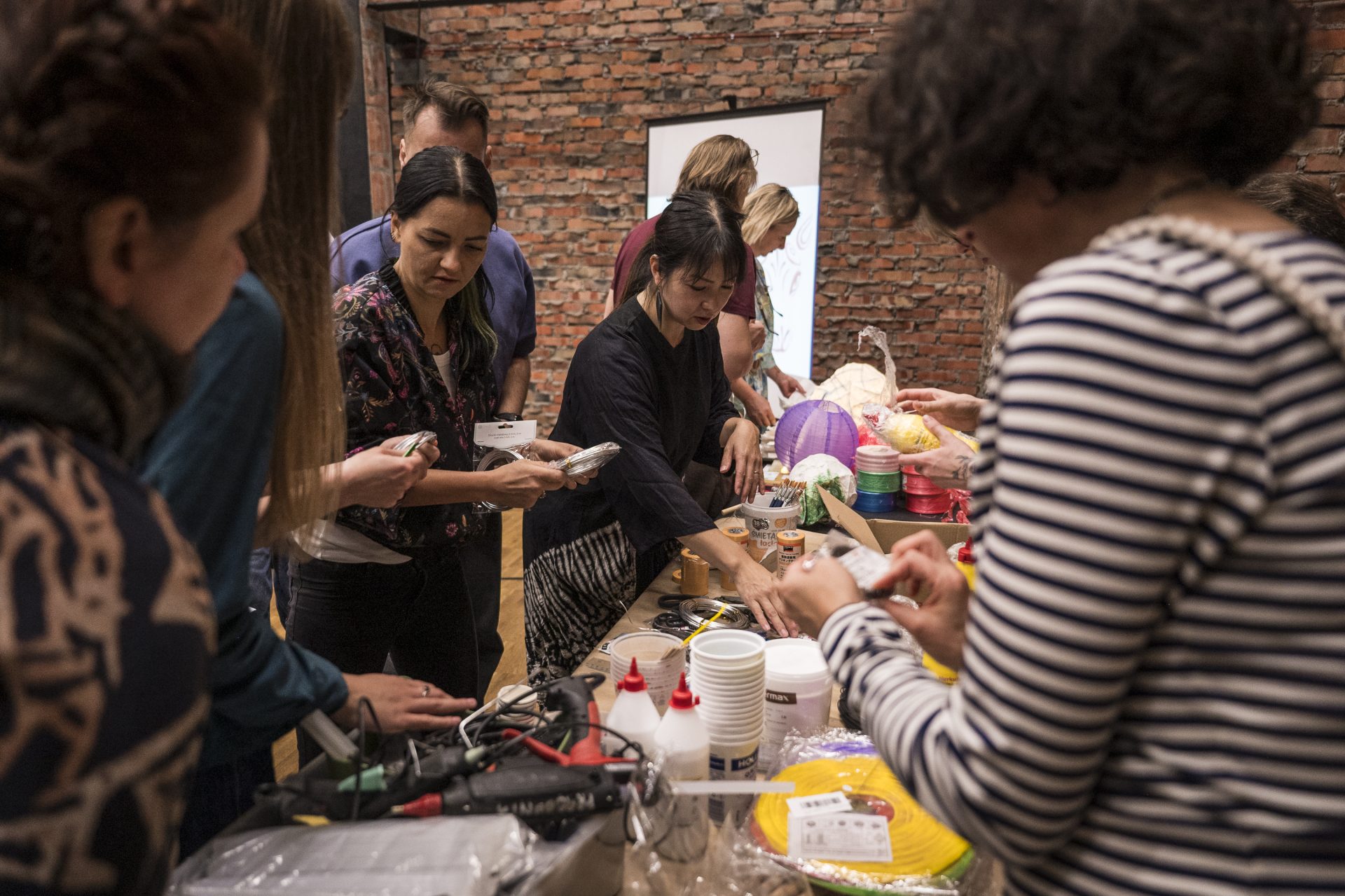
“Those were two incredibly intense and inspiring days. A new Polish Hyakki Yagyō, or Night Parade of One Hundred Demons, was born in Lublin,” Japanese artist Yumi Hayashi wrote on social media. In late September, Hayashi led a workshop at the Hans Christian Andersen Theatre as part of the Puppets and People II series.
Hyakki Yagyō is a motif rooted in Japanese folk beliefs, depicting a nocturnal parade of yōkai – demons, spirits and other fantastical creatures. For centuries, it has also been present in Japanese art. During the workshops in Lublin, participants worked on their own version of this extraordinary procession.
“Using Japanese yōkai and other supernatural creatures as the theme, everyone made their own puppet,” Hayashi says. “I also learnt a great deal from the participants. It was a truly valuable experience for me,” she adds.
The workshops, coordinated by the Hans Christian Andersen Theatre in Lublin, were part of the second edition of an international project devoted to theatre craftsmanship, puppet-making and the broader field of theatre of form. The idea grew out of a question: who is more important in puppet theatre – the puppets or the people?
“Without people, a puppet remains an object, but it is the puppet that makes it possible to tell stories on stage in ways that cannot be achieved through the presence of an actor alone. That is why we are interested in both puppets and people – in the form itself as well as in those who devise it, construct it, bring it to life and give it meaning,” emphasises Agata Sakowicz, the originator of the workshops.
Among the participants were professionals from the field, including theatre craftspeople, puppet constructors, technologists and staff working in theatre art workshops. Without their knowledge, experience and skills, many artistic ideas would never make it onto the stage.
Japanese theatre of form
This was another meeting held as part of the Puppets and People workshops. This year’s edition has a particularly strong Japanese focus. During a visit to Japan made possible through cooperation between European Capital of Culture Lublin 2029 and EU-Japan Fest, the project coordinators had an opportunity to explore Japanese theatre of form more closely – its traditions and remarkable craftsmanship, as well as contemporary approaches to puppets, materials and animation. This experience became one of the inspirations for the second edition of the project.
This is why three artists with connections to Japan were invited to Lublin this year: Yumi Hayashi, Hidetaka Yabuki and Noriyuki Sawa. Each brings a different set of experiences, techniques and ways of thinking about form. Participants have an opportunity not only to learn specific working methods from them, but also to meet, talk, and compare their own experiences with entirely different theatrical traditions.
“We want to create a recurring international space for meetings and hands-on training for this professional community. A place where people can acquire new skills, but where exchanging experience is equally important – seeing how others work, what materials they use, how they solve construction problems and how people in different parts of the world approach the construction and animation of puppets and theatrical forms,” Sakowicz explains.
The Puppets and People II workshops form part of the Hans Christian Andersen Theatre’s preparations for Rehab, a project included in Lublin’s ECoC 2029 bid book and one of the key initiatives within BORDERS, under the OUTER RIMS programme line. The initiative focuses on culture-based psychological and social support. It is being delivered by the Hans Christian Andersen Theatre in Lublin.
The workshops took place on 28–29 September at the Hans Christian Andersen Theatre in Lublin.
The project is co-financed by the Ministry of Culture and National Heritage under its “Teatr” (“Theatre”) programme.
Author: Tomasz Kowalewicz
Translated by Aleksandra Górecka
Proofread by Gabriela Niewadzi