Establishment of the Team
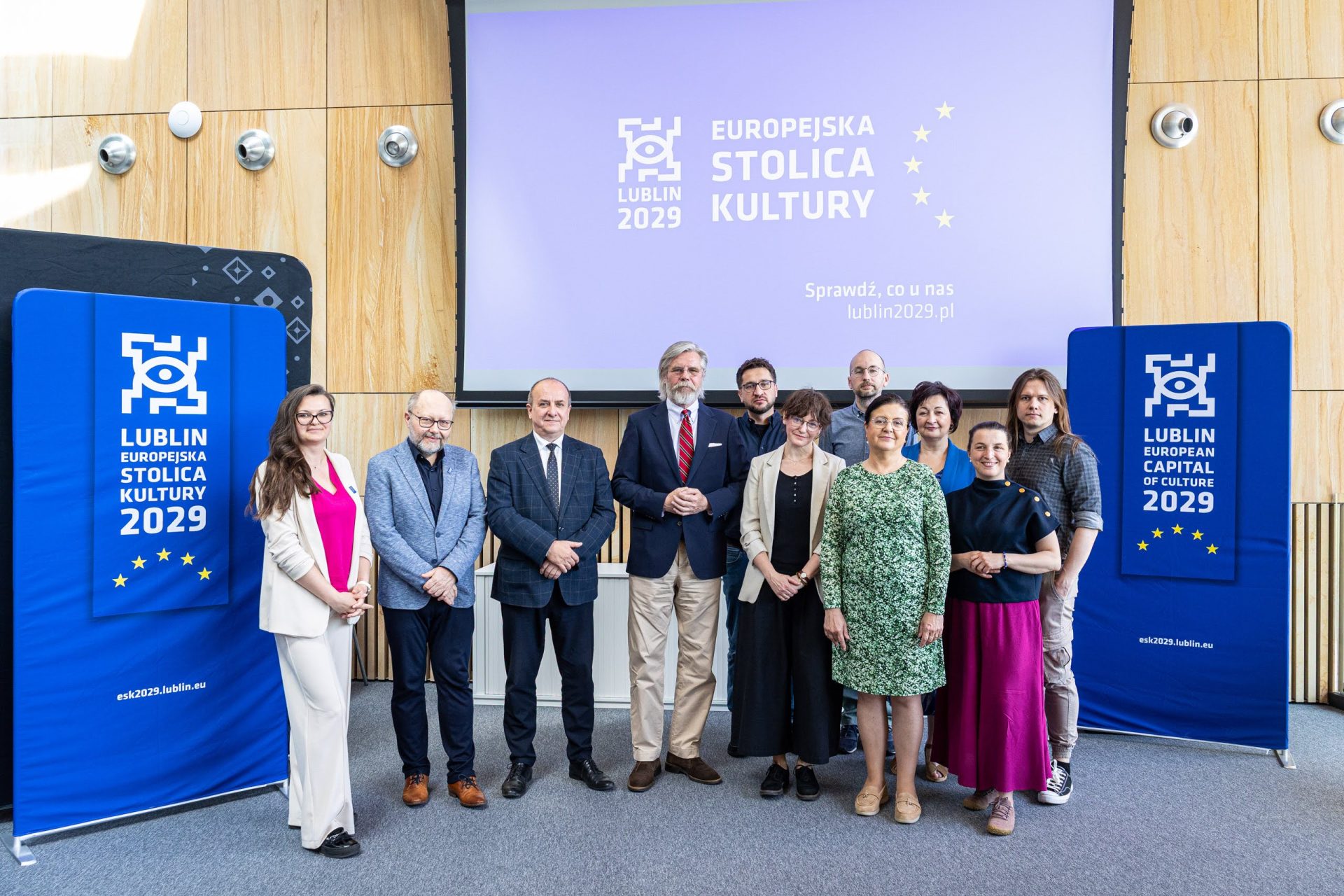
The Monitoring and Evaluation Team for the European Capital of Culture Lublin 2029 (hereinafter referred to as the ECoC 2029 M&E Team) was established during the preparation of Lublin’s bid for the European Capital of Culture competition in 2024. At that stage, the authors of the bid invited a broad group of researchers representing different communities and professional backgrounds in Lublin to contribute to the development of the monitoring and evaluation framework. Ultimately, nine people remained involved in the Team, having decided to commit to the initiative and develop a framework for researching and evaluating the entire ECoC process in Lublin.
The framework developed by the Team and included in the competition application (the so-called bid book) was recognised by European Union experts. Following Lublin’s successful bid, Paweł Potoroczyn, Director of the newly established ECoC Lublin 2029 institution, formally entrusted, in November 2025, the same individuals who had been involved in developing the framework with responsibility for carrying out the monitoring and evaluation process. This was established through Order No. 04/11/2025.
In April 2026, an official agreement was signed between Maria Curie-Skłodowska University (UMCS) and the ECoC Lublin 2029 institution, defining the scope of cooperation and the principles governing the work of the Interdisciplinary Research Team for Monitoring and Evaluation of ECoC Lublin 2029.
The agreement was concluded with UMCS as the institutional partner providing the formal and organisational framework for cooperation with ECoC Lublin 2029. This does not mean, however, that the M&E Team is a team belonging to a single university. From the outset, it has been conceived as interdisciplinary, diverse in terms of professional and institutional backgrounds, and open to collaboration. Its members include people associated with different institutions, organisations and research practices.
Within this model, UMCS provides a stable organisational base and research infrastructure, while the monitoring and evaluation framework itself remains open to cooperation with other universities in Lublin, civil society organisations, cultural institutions and experts.
The Team’s Character and Responsibilities
The Team currently brings together researchers representing a range of professional environments, including academia, non-governmental organisations and public administration. This composition makes it possible to combine several perspectives: academic methodological rigour, practical experience of working with residents and organisations, an understanding of Lublin’s cultural sector, and institutional knowledge of how the city operates.
The Team’s diverse composition is intended to ensure that ECoC monitoring is neither merely a technical reporting procedure nor a one-sided assessment of the project. Instead, it is conceived as a process grounded in dialogue, evidence and critical reflection. Its role is to systematically collect, analyse and interpret knowledge about how the project affects the city, the cultural sector, institutions, civil society organisations, and Lublin’s residents.
Monitoring and evaluation are not intended simply as a final assessment of the project. In the case of Lublin 2029, they are designed to serve as a learning tool throughout the process: helping to identify needs, barriers, outcomes, tensions and areas requiring adjustment. In this way, research-based knowledge can support programme, organisational, communication and social decisions at successive stages of the preparation and implementation of the European Capital of Culture.
Principles Guiding the Team’s Work
A key principle embedded in the agreement is the independence of the M&E Team. Under its provisions, the Team operates independently and autonomously, free from political influence, institutional interests, administrative pressure, commercial or promotional expectations, and the interests of the programme operator, municipal institutions and partner organisations.
This independence applies in particular to the autonomous selection of research methods and indicators, the independent interpretation of findings, freedom to formulate conclusions and recommendations, and the right to publish results in accordance with academic standards.
As the agreement itself emphasises: “Independence is a key condition for transparency of action, scientific integrity and public trust in the evaluation process of ECoC Lublin 2029.”
This represents a commitment to Lublin’s residents, the cultural sector and the wider European community: research will be conducted with the highest standards of academic rigour, based on three European principles — independence, transparency and methodological integrity.
Research Focus
The ECoC 2029 programme envisages a particularly comprehensive research approach for Lublin. The M&E Team’s objective is not only to monitor the implementation of the programme, but also to develop a deeper understanding of the mechanisms of social and cultural change taking place in the city and the region.
The planned research activities will include, among other areas:
* analysing participation in culture and changes in residents’ social and cultural practices;
* examining the programme’s impact on social capital and relationships between different groups;
* assessing its economic impact, including effects on the creative sector and the local economy;
* identifying long-term institutional and image-related effects.
A key element of the approach is its interdisciplinary nature and the combination of quantitative and qualitative methods. This will make it possible to capture both measurable programme outcomes and more complex, less tangible social processes.
The Team also aims to bring the findings into international knowledge networks through academic publications, participation in research networks and cooperation with European centres specialising in cultural and urban policy research.
Plans for 2026
The Team will begin its work by examining the potential for participation in culture. ECoC Lublin 2029 is not only a programme of artistic events; it also raises questions about access to culture, residents’ agency, the visibility of different groups, and the quality of cooperation between institutions, organisations and local communities.
For this reason, the Team will engage with both those who create and shape cultural life — cultural institutions, non-governmental organisations, creators, artists, cultural animators and informal initiatives — and those who participate in culture: residents of different districts, young people, older people, new residents with migration experience, people in more difficult economic circumstances, and people who face barriers to accessing culture.
The Team’s work will not focus solely on the question of who participates in culture. It will also ask who remains outside its mainstream and why. This means taking into account both active participants in cultural events and people who engage with cultural provision only occasionally or not at all.
From this perspective, the European Capital of Culture is understood as an urban process: one that concerns not only the city centre and its most visible institutions, but also neighbourhoods, residents’ everyday practices and groups whose voices are less frequently heard in public debate.
The members of the Team are:
a. Dr hab. Agnieszka Kolasa-Nowak, Professor at UMCS — Department of Sociology of Social Change
b. Dr hab. Radosław Mącik, Professor at UMCS — Department of Management Research Methods
c. Dr Andrzej Stawicki — UMCS, Department of Sociology of Social Change
d. Dr Karolina Podgórska — UMCS, Department of Sociology of Social Change
e. Dr Monika Ratajczyk — UMCS, Department of Management Research Methods
f. Dr Małgorzata Dziekanowska — UMCS, Department of Sociology of Social Change
g. Agnieszka Duda-Jastrzębska — representative of the Lubelska Grupa Badawcza Association
h. Mateusz Wawruch — representative of public administration
i. Mateusz Stępniak — representative of public administration
The work of the M&E Team is coordinated by Dr Monika Ratajczyk — UMCS, Department of Management Research Methods.